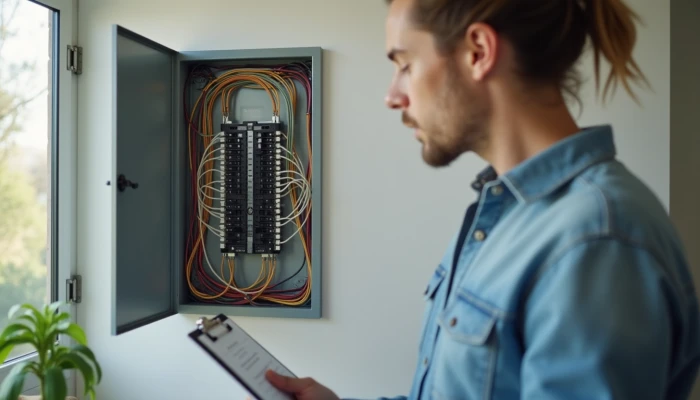
Will Your Electrical Panel Handle a Heat Pump Without an Upgrade?
A heat pump upgrade can look simple on paper and still run into one very practical problem: your electrical panel may not have enough capacity, space, or the right circuit setup to support it.
That does not automatically mean you need a full service upgrade. But it does mean you need to check the basics before you schedule equipment, compare bids, or assume a contractor can "make it work" with the panel you already have.
For most households, the key questions are straightforward:
- What electrical load does the heat pump actually require?
- How much unused capacity does the existing panel have?
- Is the issue total service size, breaker space, wire size, or all three?
- Would a subpanel or load-management approach solve the problem, or is a full upgrade more realistic?
This home electrification guide walks through those steps in plain language so you can spot likely bottlenecks early and have a more informed conversation with an HVAC installer or licensed electrician.
Understanding Heat Pump Electrical Requirements
The first step is to ignore rough guesses like "all heat pumps need a 30-amp breaker" or "a 100-amp panel is always too small." Heat pump electrical needs vary by system type, size, and manufacturer.
The most useful numbers are usually on the equipment nameplate or in the manufacturer's installation documents:
- MCA (Minimum Circuit Ampacity) tells you the minimum circuit capacity the unit needs.
- MOCP (Maximum Overcurrent Protection) tells you the largest breaker or fuse allowed for that unit.
Those two ratings drive breaker sizing and conductor sizing. In other words, the installer should not pick a breaker first and hope the rest lines up.
Common installation guidance and code references also point to the branch circuit needing ampacity of at least 125% of the applicable load for this type of equipment. That is one reason a unit with a modest running draw can still require a larger circuit than many homeowners expect.
Wire size matters too. Some smaller systems may fit on lighter wiring, but many central heat pump installations need heavier conductors. Practical guidance often notes that 10 AWG copper is common for many smaller whole-home units, while larger systems may need more capacity. The exact answer depends on the unit's MCA, the conductor type, temperature rating, and local code interpretation.
A simple way to think about it is this:
| Item | What it tells you | Why it matters |
|---|---|---|
| MCA | Minimum circuit ampacity | Helps determine minimum wire and circuit capacity |
| MOCP | Maximum breaker or fuse size | Sets the upper limit for overcurrent protection |
| Panel space | Whether you have physical room for the breaker | Even a panel with enough amperage can still be full |
| Service size | Total electrical capacity for the home | Affects whether the added load is realistic |
Heat pumps also do not all draw the same amount of current. Smaller ductless units may be on the lower end, while larger whole-home systems can require much more. That is why the equipment submittal or nameplate matters more than broad online averages.
If you are comparing bids, ask each contractor for the exact MCA and MOCP for the proposed system. That one step can prevent confusion later.
Assessing Your Electrical Panel Capacity
Once you know the heat pump's electrical requirements, the next question is whether your existing panel can support them.
This is partly about total capacity and partly about practical constraints inside the panel. A home can have enough theoretical service size and still need changes because the panel is physically full, the existing loads are already heavy, or the available breaker positions are not suitable.
Start with a basic assessment:
- Find the panel's main rating, such as 100A, 150A, or 200A.
- Check whether there are open breaker spaces for a new 240-volt circuit.
- List other major electrical loads already in the home.
- Compare those loads with the proposed heat pump MCA and MOCP.
- Ask whether any large loads are likely to run at the same time.
Major loads worth noting include:
- Electric range or oven
- Clothes dryer
- Water heater
- EV charger
- Well pump
- Hot tub or spa equipment
- Workshop tools
- Central air or existing electric heat
- Sump pump battery backup charger or other always-connected backup equipment
This does not replace a formal load calculation, but it helps you spot obvious pressure points. If you already have several 240-volt appliances and are adding a central heat pump, the panel may be tighter than it first appears.
Here is a simple readiness checklist you can use before calling an electrician:
- I know my panel's main service rating.
- I know whether the panel has open spaces for a double-pole breaker.
- I have the proposed heat pump's MCA and MOCP.
- I have listed other major electric loads in the home.
- I know whether I am also planning EV charging, a heat pump water heater, or an electric range.
- I know if the panel is already crowded, outdated, or showing signs of prior modifications.
A few warning signs suggest you should expect a closer review:
- A 100-amp service with several existing large electric loads
- No open breaker spaces
- Tandem breakers added to make room in a panel not designed for them everywhere
- Planned electrification projects happening close together
- Older equipment where labeling is missing or unclear
This is also where broader home electrification planning helps. If you expect to add EV charging, a heat pump water heater, or induction cooking later, it is worth evaluating the whole roadmap now instead of treating the heat pump as a one-off project.
For households also thinking about backup power, this planning step matters there too. A battery backup for home use, a portable power station, or a solar generator may support selected loads during outages, but those systems do not solve a panel capacity problem for a permanently installed heat pump circuit.
Upgrade Options and Cost Considerations
If your panel is not ready, that still does not mean there is only one fix. The right option depends on whether the problem is service size, breaker space, wiring, or code compliance.
Common upgrade paths include:
- Adding a new circuit only if the panel has capacity and space, but the heat pump simply needs its own correctly sized breaker and conductors
- Adding a subpanel if the main panel is crowded but the overall service may still be adequate
- Replacing the main panel if the equipment is outdated, full, or undersized for current and future loads
- Upgrading service from 100A to 200A if the home's total electrical demand is moving beyond what the existing service can reasonably support
A subpanel can be a useful middle ground when the issue is mainly space and circuit organization. It is not a magic workaround for an undersized service, but it can be more cost-effective than a full replacement in the right situation.
For full upgrades, published contractor pricing examples place a typical 100A-to-200A panel upgrade in the rough range of $5,050 to $7,350, including common code-related items and permitting. Actual pricing can vary by region, utility requirements, meter work, grounding updates, wall repairs, and whether the service entrance also needs changes.
This is a good place to separate three different cost questions:
| Question | What it covers |
|---|---|
| Do I need a new breaker and wire? | Heat pump branch circuit only |
| Do I need a new panel? | Interior panel replacement or expansion |
| Do I need a service upgrade? | Utility-side and main service capacity changes |
Tax incentives may help in some cases. Guidance on federal incentives commonly notes that qualifying panel upgrades can receive a tax credit of up to 30% of project cost, capped at $600, when installed with qualifying energy-efficiency improvements and when other eligibility rules are met. Because incentive rules can change and have conditions, it is worth confirming current requirements before relying on them.
When comparing quotes, ask each contractor to break out:
- Panel replacement cost
- New circuit cost for the heat pump
- Permit and inspection fees
- Utility coordination, if needed
- Grounding or code-correction work
- Whether the quote assumes future loads such as EV charging
That makes it easier to compare a minimal fix with a more future-ready upgrade.
Key Factors for Resilient Home Electrification
A panel decision is easier when you treat it as part of a larger plan instead of a single appliance project.
A heat pump may be the first major electrification upgrade in your home, but it is rarely the last. If you expect to add an EV charger, electric water heating, or other large loads later, a short-term workaround can become an expensive detour.
A practical sequence looks like this:
- Confirm the proposed heat pump's MCA and MOCP.
- Review the existing panel rating, open spaces, and visible condition.
- List current and likely future major electric loads.
- Get a licensed electrician to perform a formal load calculation.
- Decide between a circuit addition, subpanel, panel replacement, or service upgrade.
- Coordinate electrical and HVAC work before equipment is ordered.
This approach supports resilience in a plain, practical sense. It reduces the chance of project delays, surprise change orders, and a panel that is maxed out right after one upgrade.
It also helps you think clearly about backup priorities. If outage planning matters to you, the panel conversation may overlap with transfer equipment, critical-load planning, or selective backup for essentials like refrigeration or a sump pump. But those are separate design questions from whether the heat pump itself can be legally and safely added.
A few principles are worth keeping in mind:
- Size the electrical work for realistic future needs, not only today's minimum.
- Do not assume every home needs 200A service, but do not assume 100A is enough either.
- Treat manufacturer ratings and code compliance as the starting point, not optional details.
- Use a licensed electrician for final load calculations and permitting decisions.
Heat pumps can fit into many homes, but not every home has the same panel constraints, existing loads, or upgrade path. A careful assessment is what turns home electrification from a vague idea into a workable project plan.
Conclusion
Checking panel readiness before installing a heat pump is one of the most useful planning steps you can take. It helps you understand whether the real issue is ampacity, breaker sizing, panel space, or total service capacity.
That early assessment can prevent stalled projects, rushed electrical changes, and quotes that are hard to compare. It also gives you a better foundation for future upgrades, whether that means EV charging, water heating, or other practical home electrification projects.
The safest next step is simple: get the exact MCA and MOCP for the heat pump you are considering, then have a licensed electrician review your existing panel and perform a proper load calculation. That keeps the project grounded in code, safety, and the realities of your home rather than generic assumptions.