Keeping a Portable Power Station Safe in Humid Conditions
Humidity is easy to overlook until a backup device sits unused for months and then fails when you need it. For a portable power station or so-called solar generator, moisture is not just a comfort issue. It can affect metal contacts, internal electronics, and battery performance over time.
That matters for home energy resilience. If you keep backup power for outages, storm season, a fridge, medical devices, or a sump pump, storage conditions are part of reliability.
The good news is that protecting a unit in a humid climate usually does not require expensive gear. A few practical habits around dry storage locations, temperature ranges, and routine inspection can lower the risk of moisture-related damage without turning storage into a complicated project.
Understanding Humidity Risks for Portable Power Stations
High humidity creates two main problems for portable power equipment: moisture on components and long-term stress on the battery system. Even when a unit looks dry from the outside, damp air can contribute to corrosion on connectors, ports, and internal metal parts.
That corrosion may not cause immediate failure. More often, it shows up gradually as unreliable charging, poor connection at outlets or ports, or erratic behavior after long storage.
Moisture also raises the chance of condensation. This is especially important when a power station moves between cool and warm spaces. A unit brought from an air-conditioned room into hot, humid air, or the reverse, can collect moisture on surfaces and around openings.
Common implementation guidance for lithium-based power stations also warns against prolonged storage in damp areas because battery performance and electronics reliability can both suffer over time.
Here is the practical takeaway:
- Humid air can speed up corrosion.
- Condensation can create short-circuit risk.
- Long-term damp storage can reduce reliability even if the unit still powers on.
That does not mean every humid room will ruin a battery backup for home use. It means humidity should be treated as a real storage condition, not an afterthought.
Optimal Storage Conditions for Humidity Control
The safest approach is to store the unit in a stable indoor environment rather than chasing a perfect number. Many practical storage recommendations point to moderate humidity and mild temperatures, with manufacturer guidance taking priority if your model specifies something narrower.
A useful general target is a relative humidity range of about 35% to 65%, along with storage temperatures commonly cited around 32°F to 77°F (0°C to 25°C). Some guidance for lithium battery storage prefers an even narrower middle range, but the main goal is consistency rather than frequent swings.
If your home has several possible storage spots, compare them like this:
| Location | Humidity risk | Temperature stability | Good choice? |
|---|---|---|---|
| Interior closet | Low to moderate | Usually stable | Often yes |
| Conditioned bedroom or hallway closet | Low | Stable | Usually yes |
| Basement | Moderate to high | Can be cool but damp | Often no |
| Garage | Moderate to high | Often swings widely | Often no |
| Shed | High | Usually unstable | No for most units |
Dry storage locations usually share a few traits:
- They are inside the conditioned part of the home.
- They stay away from leaks, damp concrete, and exterior walls.
- They avoid large day-to-night temperature swings.
- They are not exposed to direct sun.
If you are storing a unit for outage backup, choose a place that is both dry and easy to access. The most protected location is not always helpful if it takes too long to retrieve during a power outage.
Using Silica Gel Packets for Moisture Absorption
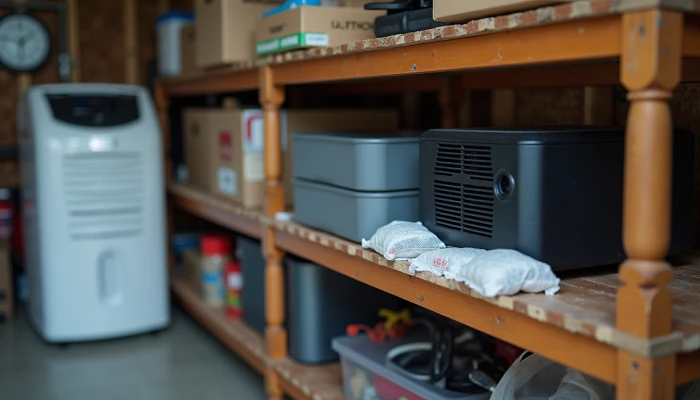
Silica gel packets can help reduce moisture inside a storage container, cabinet, or bin. They do not replace proper storage conditions, but they can add a useful extra layer of protection in humid climates.
The basic idea is simple: desiccants absorb moisture from the air in a confined space. That is most effective when the storage area is reasonably enclosed. Tossing a few packets into an open room will not do much. Placing them in a storage tote, cabinet, or latching container near the power station is more useful.
A simple setup looks like this:
- Put the power station in a clean, dry storage container or cabinet.
- Add silica gel packets sized for the enclosed space.
- Keep packets away from fan openings or vents so airflow is not blocked.
- Check the packets on a regular schedule.
Some indicating desiccants change color as they absorb moisture. If yours transition from blue to pink, that typically signals saturation and the need for replacement or recharge, depending on the product instructions.
A few cautions matter here:
- Do not assume silica gel packets alone prevent damage.
- Do not seal a damp unit into a container with desiccants and expect that to solve the problem.
- Do not block ventilation openings if the unit is stored in a case or bin.
If the power station was recently used outdoors in muggy weather, let it dry in a conditioned indoor space first. Then place it into storage with fresh desiccant. That sequence works better than trying to trap moisture and absorb it later.
Avoiding Moisture-Prone Storage Locations
Where you store the unit matters as much as how you store it. Many homes have convenient spots that are actually poor choices for electronics: basement floors, garage shelves near exterior doors, laundry rooms, and sheds.
These areas often combine three problems at once: damp air, temperature swings, and condensation risk. A portable power station stored against a cool wall or directly on concrete can face more moisture exposure than one kept a few feet away in the same room.
Use this quick checklist when choosing a location:
- Keep the unit off the floor on a shelf, riser, or stable platform.
- Leave a small air gap around the sides rather than pushing it tight against a wall.
- Avoid direct sunlight, windows, and heat sources.
- Skip rooms with known leaks, musty smells, or visible condensation.
- Prefer a sealed but not airtight storage approach if using a container, and avoid wrapping the unit in plastic that can trap moisture.
A good compromise is often a closet in the conditioned part of the home with a small container of desiccant nearby. That is usually better than a garage, even if the garage feels more convenient for emergency gear.
For households using backup power for outages, this is also a planning issue. If your battery backup for home needs include a fridge, modem, or medical equipment, storage should balance protection with quick access. Dry and reachable is better than hidden and forgotten.
Regular Maintenance Practices for Humid Climates
Humidity protection is not a one-time setup. A short maintenance routine helps catch problems before they affect performance during an outage.
Start with the manufacturer manual for your specific model. Storage charge level, inspection intervals, and acceptable temperature ranges can vary. If the manual gives a storage state-of-charge recommendation, follow that first. Some guidance commonly suggests around 50% charge for long-term storage when the manufacturer permits it, but that should not override the brand's instructions.
A simple maintenance routine can look like this:
- Inspect the casing, ports, and cable connections for dust, corrosion, or signs of moisture.
- Wipe the exterior with a dry cloth after use in humid conditions.
- Confirm the storage area still falls within reasonable temperature ranges.
- Check silica gel packets and replace or recharge them if saturated.
- Recharge or cycle the battery at the interval recommended by the manufacturer.
Watch for warning signs that suggest the storage setup needs improvement:
| Sign | What it may mean | What to do |
|---|---|---|
| Musty smell near storage area | High ambient moisture | Move to a drier room |
| Condensation on nearby surfaces | Temperature swings or damp air | Improve location and airflow |
| Corrosion on ports | Ongoing moisture exposure | Clean per manufacturer guidance and relocate storage |
| Battery level dropping unusually fast in storage | Storage conditions or battery issue | Review manual and inspect environment |
If the unit has been exposed to visible moisture, do not rush to use it. Disconnect accessories, move it to a dry indoor location, and follow the manufacturer’s safety guidance before charging or operating it again.
For most households, this level of maintenance is enough to keep a portable power station ready without turning it into a constant chore.
Conclusion
A portable power station can be a useful part of a practical home backup plan, but humid storage conditions can quietly shorten its reliability. The most effective approach is not complicated: use dry storage locations, stay within reasonable temperature ranges, add silica gel packets in enclosed storage when appropriate, and check the unit on a regular schedule.
Those steps do not guarantee damage prevention, and they do not replace the manufacturer’s instructions. But they are sensible, low-cost safeguards that can reduce avoidable moisture risk and help keep backup power ready when your household actually needs it.